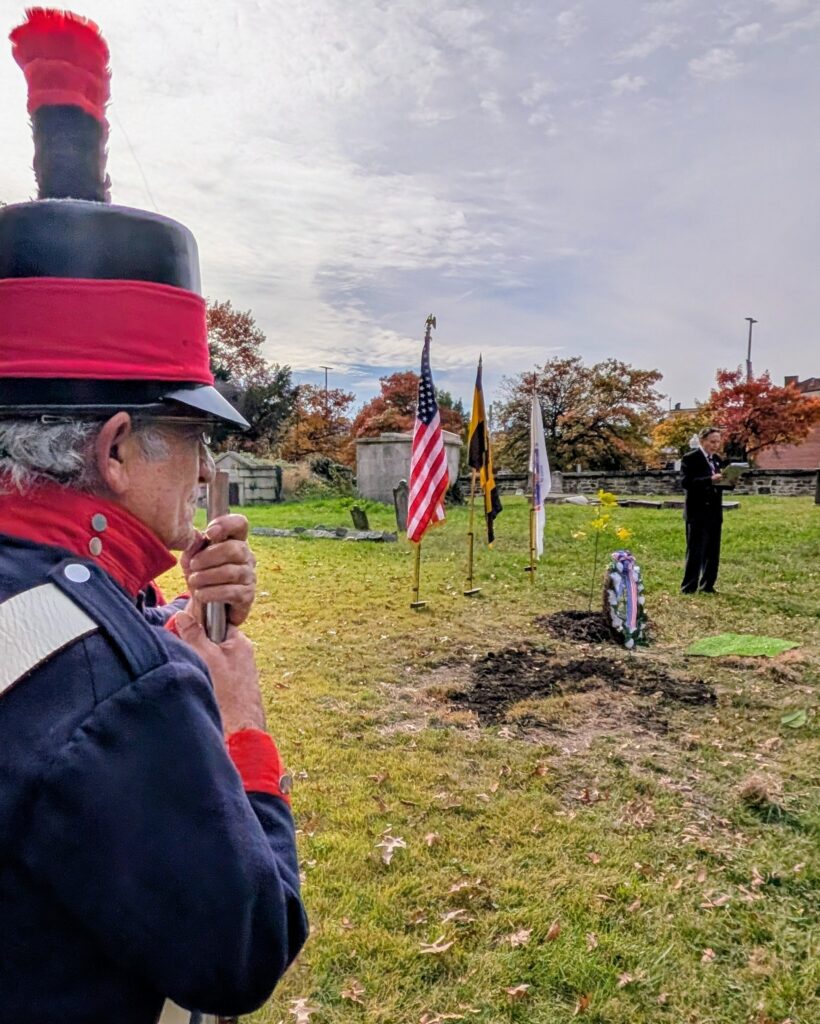
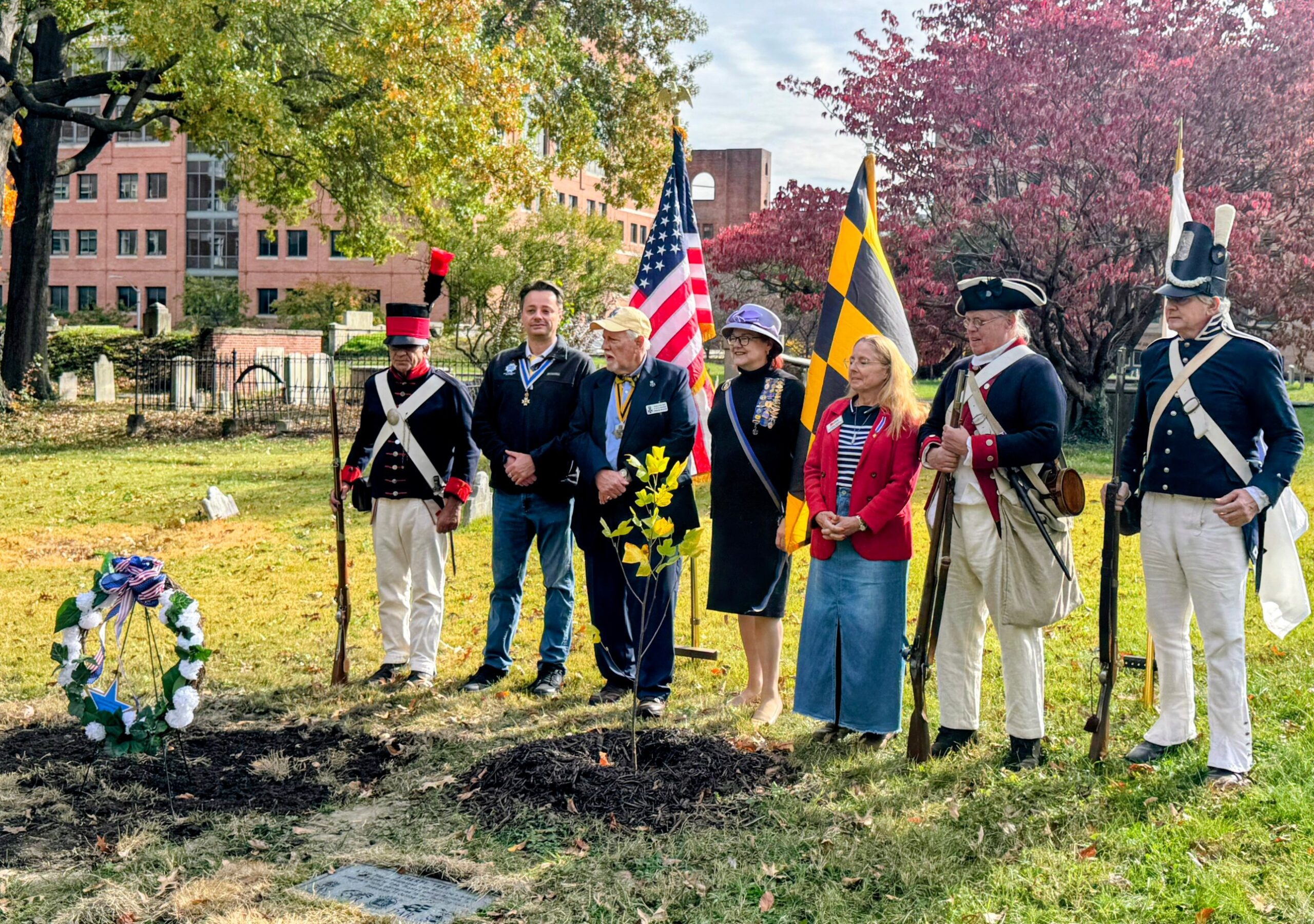
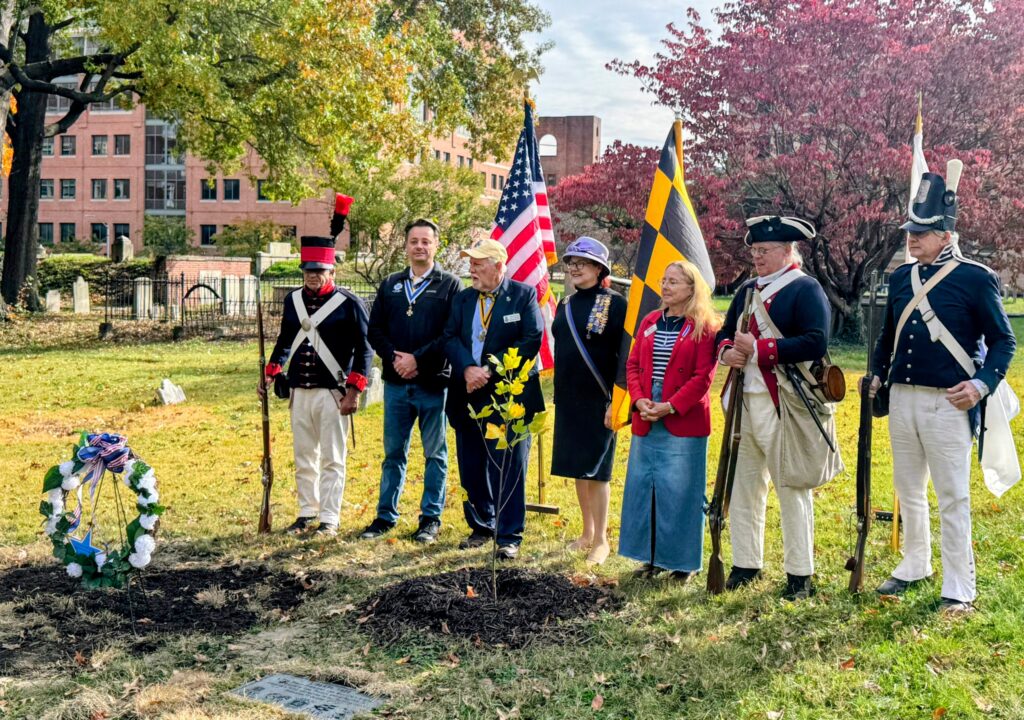
BALTIMORE, Md. On November 1, 2026, as part of the commemoration of the 250th anniversary of American independence, the Society of the War of 1812 in the State of Maryland dedicated a tulip poplar descended from Maryland’s original Liberty Tree at Old St. Paul’s Cemetery, one of the oldest burial grounds in the city.
More than 130 veterans of the War of 1812 lie at Old St. Paul’s. They rest alongside veterans of the French and Indian War, the Revolution and the Whiskey Rebellion, and alongside Samuel Chase, who signed the Declaration of Independence and served as an Associate Justice of the Supreme Court of the United States.
Among the 1812 veterans is Lt. Col. George Armistead, who commanded Fort McHenry through the bombardment of September 13 and 14, 1814. It was Armistead who commissioned a garrison flag large enough to be seen at a distance, sewn in Baltimore by Mary Pickersgill, and Armistead who had it raised over the fort when the shelling stopped. Francis Scott Key, watching from the water, wrote the verses that became the national anthem. Key was himself interred in the Howard family vault at Old St. Paul’s before his remains were removed to Frederick.
Also buried at Old St. Paul’s are Lt. Col. Jacob H. Hindman, brevetted for service at Chippewa, Fort George and Fort Erie; Christopher Hughes Jr., a United States delegate to the peace negotiations at Ghent; and Jacob Small Jr., later mayor of Baltimore, who served with the Baltimore Mechanical Volunteers at North Point.
The parent tree stood in Annapolis, where the Sons of Liberty gathered before the Revolution and where the citizens named it their Liberty Tree in September 1775. It stood until 1999, when Hurricane Floyd damaged it beyond saving. Seedlings raised from the seed of a surviving graft have been planted across Maryland.
The Society was joined in sponsoring the tree and marker by the Friends of Old St. Paul’s Cemetery, the Sons of the American Revolution, the Daughters of the American Revolution, and the United States Daughters of 1812. Color guards from the Society and from the Sons of the American Revolution presented the colors in uniforms of 1814 and of the Revolution. After greetings from the sponsoring societies, the tree and marker were unveiled, a wreath was laid, and a musket salute was fired.
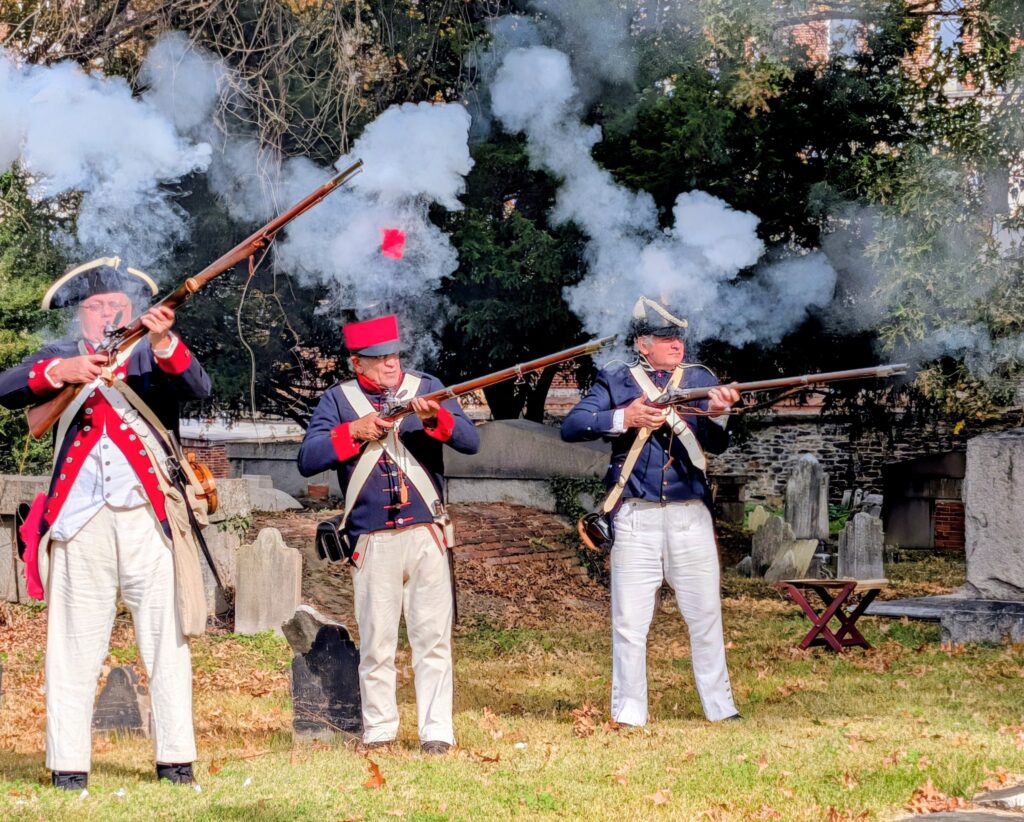
The project was coordinated by the Friends of Old St. Paul’s Cemetery, a coalition of nonprofit organizations and private citizens that cares for the grounds and the historic markers and is working toward the restoration of the burial ground.
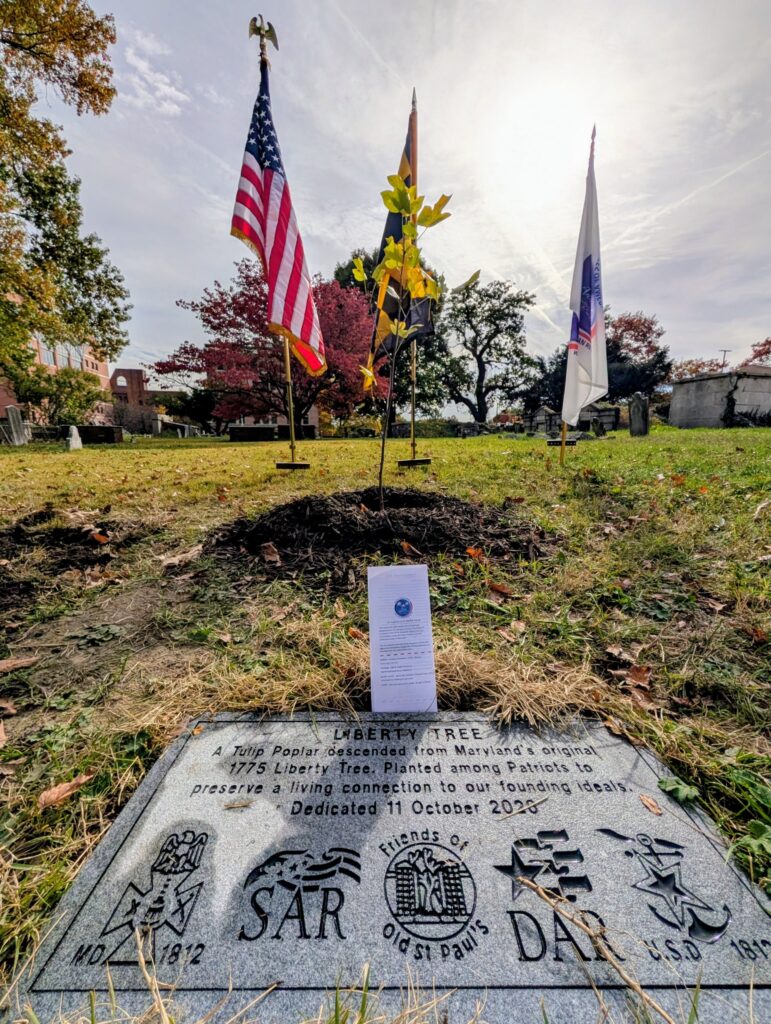
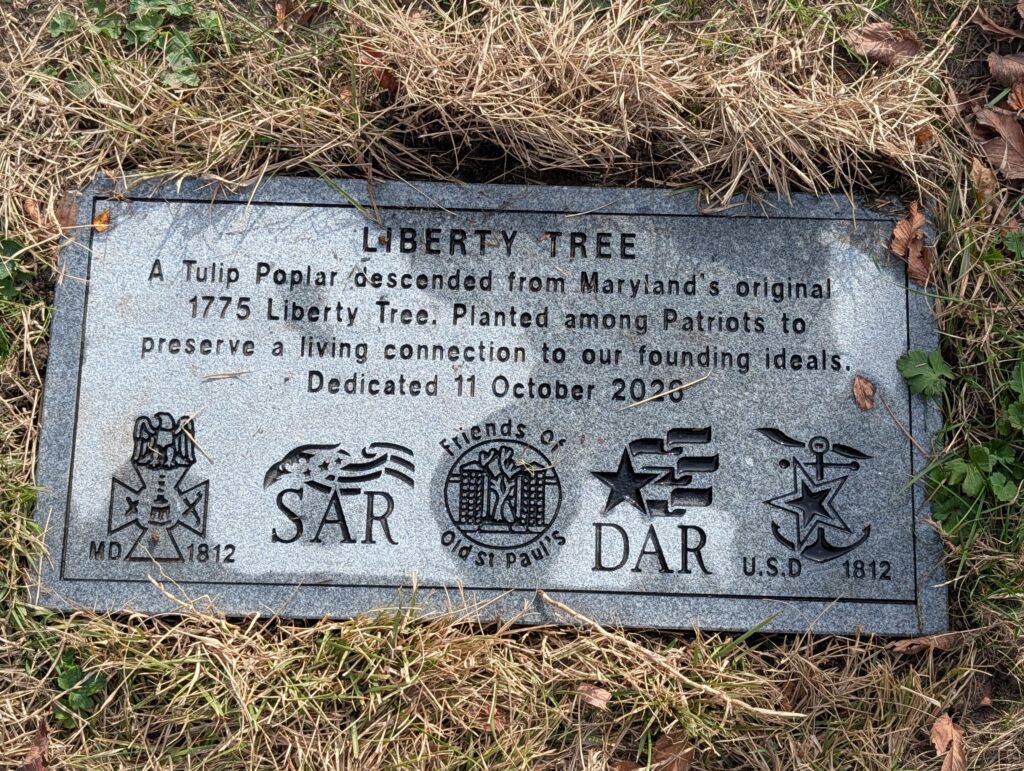
The granite marker carries the emblems of all five organizations, the Society’s first among them, and reads, in part, “Planted among Patriots to preserve a living connection to our founding ideals.” It is cut with the date first set for the ceremony, the eleventh of October. Rain that day moved the dedication to the first of November.
A descendant of the tree our forefathers gathered under in Annapolis now grows among the men who won our independence and the men who held Fort McHenry a generation later. The line runs unbroken from that tree to this ground.
William Emmerich Sr., President of the Society of the War of 1812 in the State of Maryland